Genus Spheniscus
Magellanic Penguin
マゼランペンギン Spheniscus magellanicus
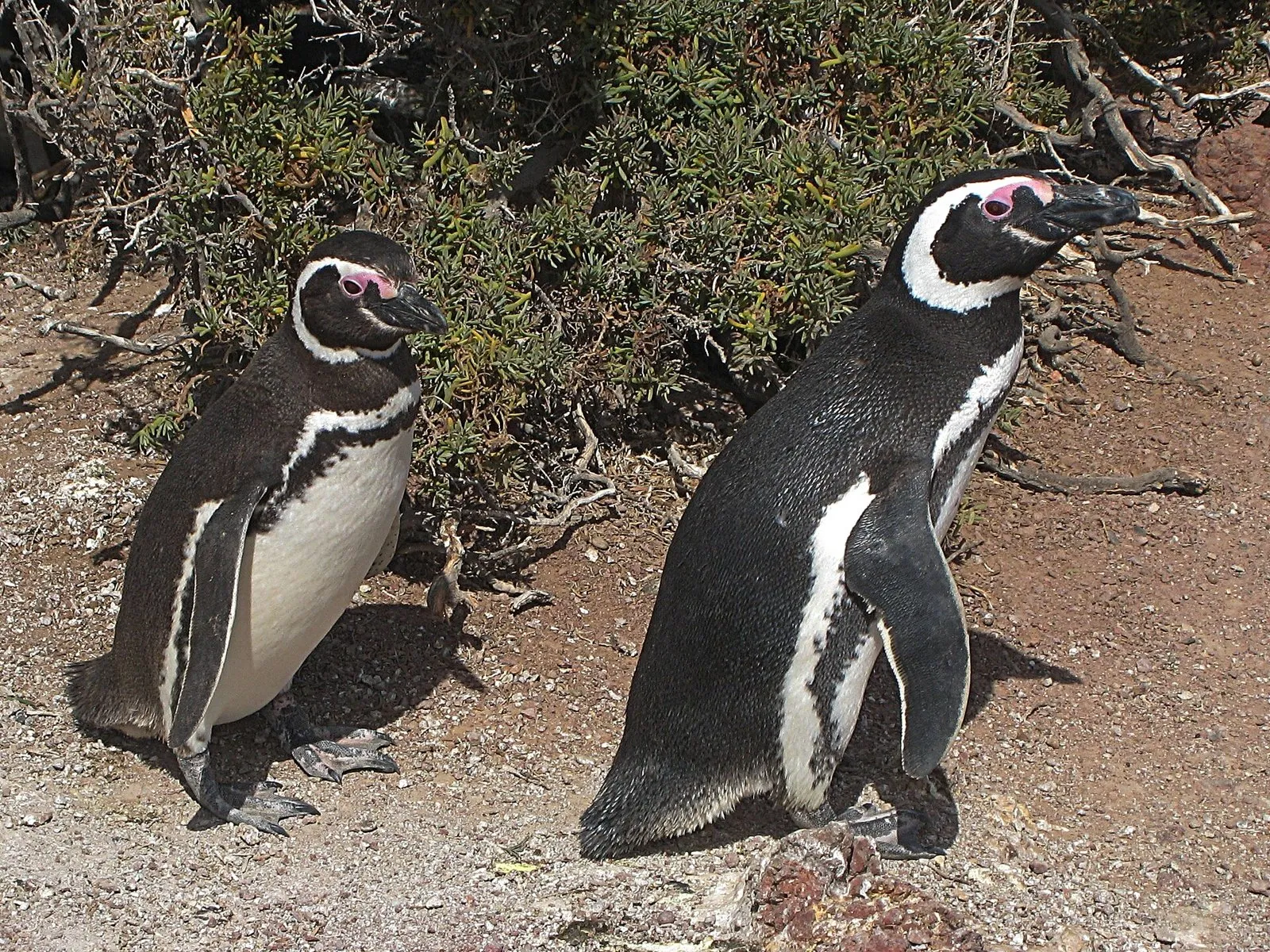
About
Forages only at sea and breeds on land in a variety of island and mainland coastal habitats, from scrubland and grassland in Argentina to tussock grass in the Falkland Islands and temperate forest in Chile. At colonies it uses intertidal areas and beaches to avoid excessive heat. It dives to almost 100 m, though more often to a few dozen metres.
Key facts
- Scientific name
- Spheniscus magellanicus
- Conservation status (IUCN)
- Least Concern (LC) — assessed 2020
- Population trend
- Decreasing
- Population
- About 1.1–1.6 million pairs (2.2–3.2 million mature individuals)
- Range
- Breeds on the Atlantic and Pacific coasts of South America in Argentina and Chile, and in the Falkland Islands (Malvinas). In the Atlantic, most birds migrate north in winter to northern Argentina, Uruguay or southern Brazil.
Where to see the Magellanic Penguin in Japan
Adventure World
Wakayama Shirahama
10 penguin species
Kobe Suma Sea World
Hyogo Suma Ward, Kobe
1 penguin species
Nagasaki Penguin Aquarium
Nagasaki
9 penguin species
Shinagawa Aquarium
Tokyo Shinagawa
1 penguin species
Sumida Aquarium
Tokyo Sumida
1 penguin species
Joetsu City Aquarium Umigatari
Niigata Joetsu
1 penguin species
FAQ
- Where can I see the Magellanic Penguin in Japan?
- At 6 places listed on PenguinSpot: Adventure World, Kobe Suma Sea World, Nagasaki Penguin Aquarium, Shinagawa Aquarium, Sumida Aquarium, Joetsu City Aquarium Umigatari.
- Is the Magellanic Penguin endangered?
- It is not threatened. The IUCN Red List classifies it as Least Concern (LC), assessed in 2020.
Sources
We checked the sources below on October 21, 2026.